
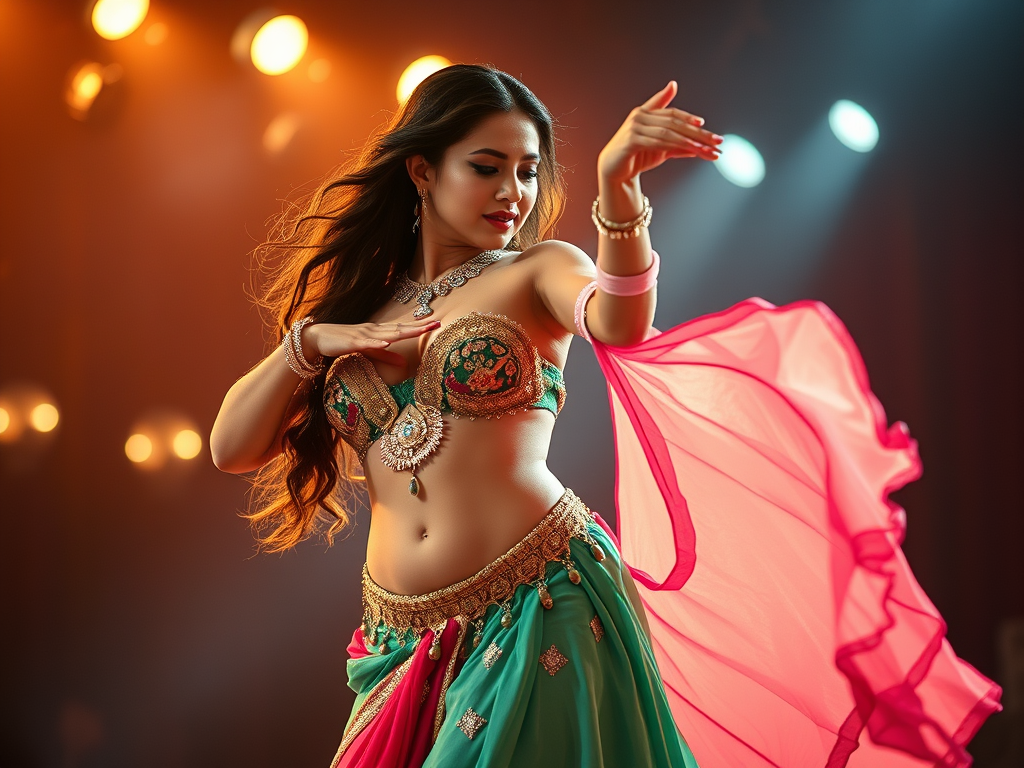
This article reflects on the history of belly dance, tracing it from ancient times to its modern evolution. It resonates with the experiences of dancers from past decades, including my own teacher who performed from the 1960s to the 1990s. It offers a glimpse into the origins and potential future of this beautiful art form.
Origins of Belly Dance
Belly dance has existed for over 5,000 years, originating before the Common Era. Some suggest that the dance was performed by women in support of a mother during childbirth, helping her move in sync with their motions. This, they believed, would confuse the Evil Eye, protecting the newborn by diverting its attention to one of the dancers. While this theory remains unproven, it’s clear that ancient Egyptians, like their modern descendants, embraced music and dance as a way to celebrate life.
From Pre-Dynastic Egypt, we see music and dance as integral parts of both religious and secular life. Numerous ancient musical instruments have been discovered, along with tomb murals depicting scenes of banquets with musicians and dancers. These early depictions were often idealized, but by the 18th Dynasty, they became more realistic, and it was during this time that Queen Nefertiti may have left her mark.
Queen Nefertiti’s Influence
Before Queen Nefertiti’s husband, King Akhenaten, rose to power, Egypt had countless temples, each dedicated to different deities. However, during Akhenaten’s reign (1352–1336 BCE), he introduced monotheism, worshiping the Sun God, Aten. Nefertiti, as his devoted follower and possibly high priestess, played a key role in this religious transformation.
Nefertiti may have also influenced the unification of dance styles in Egyptian temples. Prior to this, each temple likely had its own style, but Nefertiti might have brought these together into a unified dance in honor of the Sun God, Aten. Under her guidance, dancers performed barefoot, symbolizing their connection to both the earth and the divine. She is also believed to have introduced the practice of coloring toenails with berry juice, a tradition that continues among many belly dancers today.
Belly Dance vs. Raqs Sharqi
When I first started learning this dance in 1974, it was primarily known as “belly dance,” having originated in the streets of Egypt. It wasn’t recognized as a formal dance style in the West until the 19th century. I vividly recall seeing an ad for belly dance lessons at Jodette’s studio in Sacramento and being welcomed by an Arab woman who introduced me to this mysterious yet beautiful art form.
For decades, we called it “belly dance” and embraced the term despite its somewhat “cheesy” connotations. But as time passed, a new generation emerged, renaming it “Raqs Sharqi,” meaning “Dance of the East.” This new name offered the dance greater respect and helped distance it from the exoticized images of harem dancers that had been popularized in the West. However, it also introduced debates over its spelling, with variations such as “Raks Sharki” and “Rox Sharky.”
Despite the changes in terminology, my own journey through this dance has been rich and fulfilling. It transcends any label, remaining an expression of a unique and intriguing culture. I hope future generations preserve the authenticity of this ancient art form.
Belly Dance: An Egyptian Cultural Expression
Belly dance is a core part of Egyptian culture, not tied to any religion or goddess worship. Its origins are purely Egyptian, though many later Western interpretations have created hybrid styles. Egyptian cinema played a crucial role in popularizing belly dance worldwide, with early films featuring professional dancers in Cairo’s cabarets. These movies eventually spread across the Middle East, Europe, and the United States, introducing the world to “belly dance” or “danse du ventre,” as the French called it.
Before these films, belly dance was primarily performed live in Egyptian restaurants and cabarets, and Western.
 Doya Vibes
Leave a comment